
 EN
ENBy Elise Nacer-Khodja, Toxin Solution Product Manager EW Nutrition
The gut under siege: understanding the direct assault on epithelial integrity
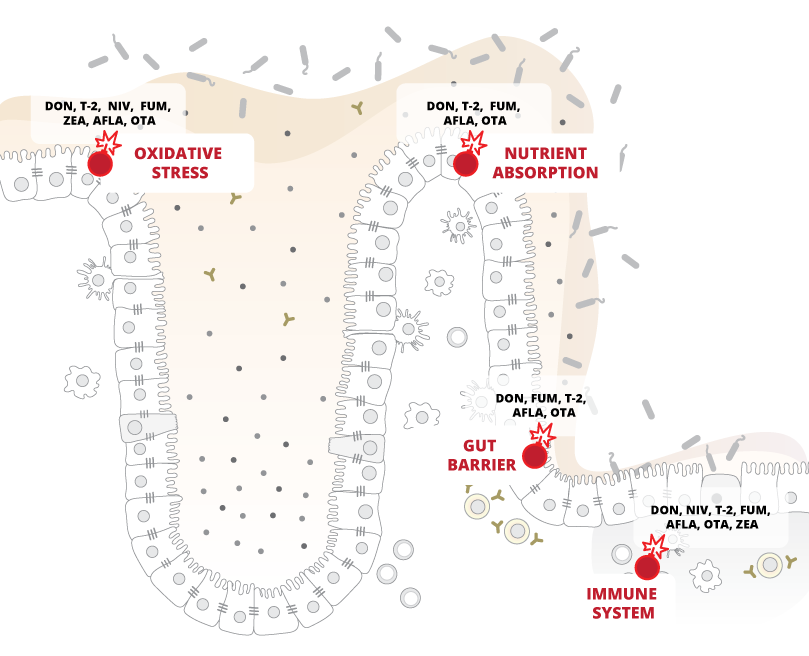
The gastrointestinal tract (GIT) is the primary site of interaction between animals and ingested mycotoxins, playing a pivotal role in the absorption and oral bioavailability of these contaminants. While high-dose clinical mycotoxicosis is rare in modern production, the chronic ingestion of low to moderate levels triggers a cascade of metabolic, physiological, and immunological disorders. The intestinal epithelium, a single layer of cells, is the animal’s most critical interface, functioning simultaneously as a nutrient harvester and a frontline barrier against pathogens and toxins.
Mycotoxins, specifically trichothecenes like deoxynivalenol (DON), and fumonisins (FB1), but also aflatoxins (AFLA) and ochratoxins (OTA) directly sabotage this barrier. They downregulate the mRNA expression of tight junction proteins, compromise cell viability, and degrade the protective mucus layer. Beyond this structural damage, mycotoxins induce a pro-inflammatory cytokine response and disrupt the gut microbiota. These alterations do more than just damage the gut; they increase susceptibility to secondary infections such as coccidiosis, necrotic enteritis, salmonellosis and many others.
Protecting the gastrointestinal tract from mycotoxins becomes an essential pillar for health and performance because GIT is not just an organ for digestion; it is the largest immune organ in the body. When its integrity is compromised, the animal’s entire biological priority shifts from growth to defense, leading to hidden performance losses that are often only noticed at the end of the production cycle.
Beyond physical damage: the catalyst for antibiotic resistance
Recent research highlights a critical link between mycotoxins and the global rise of antimicrobial resistance (AMR). While the misuse of drugs is the primary driver of AMR, toxins such as deoxynivalenol (DON) act as potent environmental catalysts. DON significantly disrupts the microbial balance of the gut, providing a survival advantage to bacteria carrying resistance genes. Furthermore, mycotoxins have been shown to activate specific bacterial resistance genes and accelerate horizontal gene transfer, allowing resistant strains to spread more rapidly through the microbiota. Bacteria employ molecular defense mechanisms against mycotoxins (such as efflux pumps and detoxification enzymes) that are similar to those used against antibiotics. This cross-resistance not only weakens therapeutic effectiveness but also creates a systemic “One Health” challenge.
From gut porosity to hepatic stress
In a study led by EW Nutrition in a research center in 2025, the oral exposure to 2 ppm of DON and 5 ppm of Fumonisin B1 from day 11 to 42 of 480 broiler chickens (Ross 308) acted as a direct assault on their intestinal and hepatic functions. Specifically:
-
Intestinal porosity was increased: a significant downregulation of the tight junction protein ZO-1 (p<0.001) expression was observed, compromising gut integrity.
-
Systemic leakage was revealed: an increased level of serum E. coli lipopolysaccharide (LPS), indicated that pathogens bypassed the degraded epithelial barrier.
-
Hepatic damage was observed: severe hepatocellular necrosis, fibrosis, and a massive upregulation of IL-6 (inflammatory interleukin) and NOX-4 (marker of oxidative stress) was measured in the liver.
The liver is the primary metabolic hub for birds. By forcing the liver to deal with an influx of intestinal pathogens and oxidative damage, mycotoxins divert energy away from muscle protein synthesis. This redirection of resources is a primary driver of poor feed conversion rates, even when the animals do not show obvious signs of illness.
Economic consequences: the true cost of a compromised barrier
The biological sabotage detailed in the EW Nutrition trial translates directly into technical failure and heavy economic losses. The exposure to DON and FB1 significantly hindered performance during the growing-finishing period:
-
Feed efficiency: The Feed Conversion Ratio (FCR) increased by 5 points (3%, p<0.01) from 11 to 42 days,
-
Growth inhibition: At 42 days, challenged birds weighed 67g less (2.5%) than the control group,
-
Productivity drop: The European Production Efficiency Factor (EPEF) decreased by 7% (p<0.01),
-
Mortality: mortality rates more than doubled, jumping from 2.50% in the control group to 6.67% in the challenged group.
For the producer, this resulted in an average loss of 0.18€ per head. In a large-scale commercial operation, these “sub-clinical” losses can represent tens of thousands of euros in lost revenue per house, largely driven by the indirect effects of gut leakage and liver stress.
Research led by Kolawole (2025) suggests that poultry producers lose $0.30 per broiler chicken due to subclinical mycotoxin exposure. By damaging gut health and weakening immune responses, these toxins reduce feed efficiency and trigger “hidden” financial leaks. Even when contamination appears low, the cumulative impact on profitability remains severe.
Securing gut barrier: a shield for profitability
To counteract these effects, the trial evaluated the capacity of EW Nutrition toxin risk solution to mitigate these mycotoxin-induced damage. The results showed that the inclusion of this solution acted as a definitive shield for the animals:
- Restored gut integrity: EW Nutrition solution significantly improved the gut condition, reducing inflammation and restoring the intestinal barrier,
- Reduced lesions: mucosal ulceration and lesion scores were greatly reduced compared to the challenged group,
- Liver protection: supplementation returned the hepatic markers IL-6 and NOX-4 to control levels, effectively neutralizing the metabolic burden and oxidative stress on the liver.
Most importantly, this biological protection translated into a full recovery of animal performance. Birds receiving the supplementation reached higher body weights (2,782g vs 2,686g in the challenge group) and mortality was halved. Overall, groups treated with EW Nutrition toxin risk solution showed the highest productivity, with an EPEF 5% to 11% higher than their respective controls.
Conclusion
Effective mycotoxin management requires a multi-layered approach. While general biosecurity measures and raw material monitoring are essential to reduce initial exposure, they are rarely enough to eliminate the risk entirely in commercial environments. This study demonstrates that even moderate levels of toxins can trigger systemic metabolic stress and gut failure. Therefore, in addition to standard preventive measures, the use of EW Nutrition’s advanced solutions, such as Solis Max 2.0, represents a highly effective lever.
With a Return on Investment (ROI) of 5:1, EW Nutrition’s approach proves that protecting the intestinal epithelium and the liver is a fundamental technical and economic requirement. By ensuring nutrients are used for growth rather than inflammation, producers can secure the profitability and health of the broiler cycle, even under significant mycotoxin challenges.
References available upon request.










 Brasil
 Colombia (ES)
 México (ES)
 United States
 Belgium (EN)
 Croatia (EN)
 Deutschland
 España
 France
 Great Britain
 Italia
 Nederland (EN)
 Österreich (DE)
 Polska
 Россия
 Schweiz (DE)
 Türkiye
 Україна (RU)
 عربى
عربى South Africa (EN)
 Morocco
 Nigeria
 Uganda
 Kenya
Kenya Tanzania
 Australia
 中国大陆
中国大陆 India (EN)
 日本
日本 Malaysia (EN)
 Philippines (EN)
 ไทย (EN)
 Việt Nam (EN)
