
 EN
ENWhat could a possible super El Nino mean for weather, crops, and livestock through 2026 and 2027?
El Nino is the warm phase of a natural climate cycle in the Pacific Ocean called the El Nino-Southern Oscillation, or ENSO. The cycle has three states: El Nino (warm), La Nina (cool), and neutral (in between).
In a normal year, steady trade winds blow east to west across the equatorial Pacific, pushing warm surface water toward Asia and Australia. During El Nino, those winds weaken. Warm water sloshes back toward the eastern Pacific and the coast of South America, releasing heat into the atmosphere. That extra heat shifts the path of the jet streams, the high-altitude air currents that steer storms. The result is a global reshuffling of where rain falls and where it does not, and the pattern can last a year or more.
The current event followed an unusually fast handoff from La Nina. NOAA officially declared El Nino on June 11, 2026, when it issued an El Nino Advisory, and forecasters expect the event to keep strengthening into the Northern Hemisphere winter, when El Nino is typically at its peak.
How strong, and how likely
Forecasters are unusually confident this time. NOAA’s Climate Prediction Center puts the odds of a very strong event during the November 2026 to January 2027 peak at about 63 percent. Strength is measured by how far sea surface temperatures in a key central Pacific zone rise above their long-term average; NOAA now tracks this with the Relative Oceanic Nino Index (RONI), which adjusts for broad tropical warming. NOAA classifies an event as very strong, the level some meteorologists informally call a super El Nino, when that figure exceeds 2.0 degrees Celsius. A very strong event would rank among the largest in the record going back to 1950. Note: The WMO cautions that terms like super El Nino are not official designations and can overstate a still-uncertain forecast.
The European Centre for Medium-Range Weather Forecasts (ECMWF) is more aggressive still. Its central projection has central Pacific sea surface temperatures climbing to roughly 3ºC above average by December, with some model runs exceeding 4ºC. If even the central figure verifies, the event would surpass the two joint record holders: 2015-16, which peaked near 2.6ºC, and 1997-98, near 2.4ºC.
The probabilities forecasters are citing:
- About 63 percent chance of a very strong event at the winter peak (NOAA Climate Prediction Center).
- An 80 percent chance that El Nino conditions emerge during June to August 2026, rising to near or above 90 percent through September to December (World Meteorological Organization, June 2 alert).
- An ECMWF central scenario near 3ºC above average, with high-end model runs above 4 degrees.
A late shift in the trade winds could still soften the peak, and a stronger event makes big impacts more likely without guaranteeing them. Human-caused warming also appears to be making the swings between El Nino and La Nina faster, which may push this event into territory with no clean historical match.
Likely weather impacts, region by region
El Nino does not bring the same weather everywhere. Its effect is a redistribution of heat and moisture, and what it means on the ground depends heavily on the region and the local crop calendar.
- Atlantic hurricanes: El Nino usually increases wind shear over the Atlantic, which tends to suppress tropical storm formation. That often means fewer high-impact storms reaching the US Gulf Coast and Southeast.
- United States winter: A persistent El Nino favors milder northern temperatures, fewer severe Arctic cold outbreaks, and a wetter, more active storm track across the southern states.
- Europe: The rapidly developing strong El Niño is already amplifying extreme summer heatwaves across Western and Central Europe. For the upcoming autumn and winter of 2026–27, a “super” El Niño is projected to increase the likelihood of a disrupted polar vortex, potentially flipping historical patterns to bring warmer-than-normal conditions that build into spring 2027.
- Southern Africa: The main concern is the 2026-27 rainy season, which starts around October 2026. This region historically sees below-average rainfall during El Nino, raising the risk of drought, water stress, and reduced grazing.
- Latin America: Forecasts point to severe dryness across Central America, the Caribbean, and Colombia, alongside above-average rainfall in parts of Bolivia, Ecuador, and Peru.
- Asia: A drier-than-normal monsoon across parts of South and Southeast Asia is a recurring El Nino feature, though week-to-week variation is large.
El Niño 2026–27Expected Regional Effects
A map of the climate shifts a strengthening El Niño tends to drive across agriculture, livestock and severe-weather risk. Tropical and trade-wind teleconnections are well established; mid-latitude effects - including Europe - are weaker and less certain, and are flagged accordingly.
During El Niño the equatorial trade winds weaken and the Pacific warm pool migrates eastward (shown in red), pulling tropical rainfall with it and rerouting the jet streams that carry these effects worldwide.
Regional impact details
Numbers correspond to the map markers.
Expected regional effects of the 2026-27 El Nino. Effects are probabilistic and depend on local crop calendars.
What this means for agriculture
The agricultural picture is genuinely mixed. The headline risk is not a single bad harvest but the chance that a super El Nino hits several major crop regions at the same time, straining global food supply chains into 2027.
The potential upside
In the US Corn Belt, the transition from La Nina to El Nino skews cautiously positive. Wetter conditions across the southern US can ease drought, help winter wheat get established, and revive pastureland, with some forecasters expecting above-trend yields. However, a favorable ENSO state does not override local weather; it is a tilt in the odds, not a guarantee.
The potential downside
An active subtropical jet stream can swing between heavy rain and dry spells, raising the risk of waterlogged fields and localized flooding.
In Southern Africa, where the rainy season aligns badly with the forecast peak, the exposure is real: South Africa’s maize harvest fell about 22% to 12.9 million tons during the mild 2023-24 drought, and dropped far further in the severe 2015-16 event. The EU’s research bodies have repeatedly warned of reduced yields in parts of Angola, Mozambique, southern Madagascar, and Tanzania during El Nino, and of dryness threatening maize and rice across Central America and the Caribbean. Combined with elevated fuel and fertilizer costs, this raises the prospect of food price pressure through 2026 and 2027.
What this means for livestock
Livestock systems are exposed through two channels: direct heat and water stress on the animals themselves, and indirect pressure through feed costs and pasture availability.
- Dairy cattle are the most heat-sensitive. Sustained heat stress cuts feed intake and milk output and degrades milk quality, because cows divert energy toward cooling themselves and eat less. A 2023 meta-analysis in the Journal of Dairy Science found heat stress lowered dry matter intake by 19.3 percent and energy-corrected milk by 17.9 percent, with reviews reporting yield losses above 20 percent at high temperature-humidity index. Higher-producing cows are the most vulnerable, since milk production itself generates metabolic heat.
- Beef cattle eat less during extreme heat, which slows weight gain and reduces production efficiency.
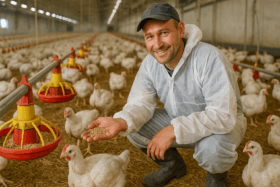
- Poultry and swine operations face higher feed costs and greater vulnerability to temperature extremes, all of which compress margins and increase health concerns and feed mycotoxin risks.
- Pasture and rangeland in drought-exposed regions, especially Southern Africa and coastal Angola, face reduced forage and elevated risk of livestock losses in the 2026-27 season.
There is a partial offset in the Northern Hemisphere. A persistent El Nino winter that suppresses severe Arctic cold outbreaks across the northern US could reduce cold-stress disruptions to livestock operations and ease winter energy demand.
The bottom line
El Nino has arrived and has a real chance, around 63 percent, of becoming one of the strongest events on record. For agriculture and livestock, the most likely outcome is heightened volatility rather than uniform loss: a cautiously favorable US row-crop year set against drought risk in Southern Africa, Central America, and parts of Asia, with heat and feed-cost pressure squeezing dairy and intensive livestock margins worldwide. Because the impacts hinge on local crop calendars and on wind shifts that are still unfolding, the practical move is to treat current outlooks as an early-warning signal and update planning as shorter-range forecasts firm up.
References
Cartwright, S.L., Schmied, J., Karrow, N. and Mallard, B.A. (2023) ‘Impact of heat stress on dairy cattle and selection strategies for thermotolerance: a review’, Frontiers in Veterinary Science, 10, 1198697. Available at: https://www.frontiersin.org/journals/veterinary-science/articles/10.3389/fvets.2023.1198697/full.
Chen, L., Thorup, V.M. and Kudahl, A.B. (2024) ‘Effects of heat stress on feed intake, milk yield, milk composition, and feed efficiency in dairy cows: a meta-analysis’, Journal of Dairy Science, 107(5), pp. 3207–3218. Available at: https://www.journalofdairyscience.org/article/S0022-0302(23)01212-2/fulltext.
ECMWF (2026) How confident should we be in a prediction of El Niño? Available at: https://www.ecmwf.int/en/about/media-centre/science-blog/2026/el-nino-2026.
International Food Policy Research Institute (2024) Southern Africa drought: impacts on maize production. Available at: https://www.ifpri.org/blog/southern-africa-drought-impacts-maize-production/.
International Research Institute for Climate and Society (2026) ENSO forecast: current. Columbia University. Available at: https://iri.columbia.edu/our-expertise/climate/forecasts/enso/current/.
National Oceanic and Atmospheric Administration (2026) El Niño forms, expected to strengthen, say NOAA forecasters, 11 June. Available at: https://www.noaa.gov/news-release/el-nino-forms-expected-to-strengthen-say-noaa-forecasters.
NOAA Climate Prediction Center (2026) ENSO diagnostic discussion. Available at: https://www.cpc.ncep.noaa.gov/products/analysis_monitoring/enso_advisory/ensodisc.shtml.
Pro Farmer (2026) Transition to El Niño signals drought relief, but global crop disruption looms, 21 May. Available at: https://www.profarmer.com/news/transition-el-nino-signals-drought-relief-global-crop-disruption-looms.
Sihlobo, W. (2026) A possible El Niño in the 2026-27 season presents risks for South Africa’s agriculture, AgriView, 18 April. Available at: https://wandile.substack.com/p/a-possible-el-nino-in-the-2026-27.
Sihlobo, W. (2026) Maize yield levels convey a key message about El Niño periods in South Africa, AgriView, 15 April. Available at: https://wandile.substack.com/p/maize-yield-levels-convey-a-key-message.
United States Department of Agriculture, National Agricultural Statistics Service (2024) Crop production 2023 summary. Available at: https://downloads.usda.library.cornell.edu/usda-esmis/files/k3569432s/ns065v292/8910md644/cropan24.pdf.
Washington State University Veterinary Medicine Extension (2025) The effects of heat stress on dairy cattle development, health, and performance, 22 April. Available at: https://vetextension.wsu.edu/2025/04/22/the-effects-of-heat-stress-on-dairy-cattle-development-health-and-performance/.
World Meteorological Organization (2026) Launch of the WMO El Niño/La Niña bulletin (June-August 2026), 2 June. Available at: https://wmo.int/content/launch-of-wmo-el-ninola-nina-bulletin-june-august-2026.










 Brasil
 Colombia (ES)
 México (ES)
 United States
 Belgium (EN)
 Croatia (EN)
 Deutschland
 España
 France
 Great Britain
 Italia
 Nederland (EN)
 Österreich (DE)
 Polska
 Россия
 Schweiz (DE)
 Türkiye
 Україна (RU)
 عربى
عربى South Africa (EN)
 Morocco
 Nigeria
 Uganda
 Kenya
Kenya Tanzania
 Australia
 中国大陆
中国大陆 India (EN)
 日本
日本 Malaysia (EN)
 Philippines (EN)
 ไทย (EN)
 Việt Nam (EN)
