
 EN
EN
Colortek Yellow versus synthetic apo-ester: performance, stability, regulation, and market fit
Synthetic apo-ester has been the default yellow pigment in layer feed for decades. This axiom is no longer valid with current evidence. Regulatory caps in the EU, an outright ban in the US, and tightening scrutiny in ANZ are shrinking the headroom producers must work with. At the same time, consumer pressure toward natural ingredients continues to mount. Colortek Yellow, EW Nutrition’s marigold-derived yellow pigment, closes the performance gap that historically made natural alternatives unattractive. At 1.25 times the apo-ester dose it delivers equivalent yolk colour fan scores across all tested targets. It outperforms apo-ester on storage stability by a factor of 2.6 at three months, and it adds antioxidant protection that synthetic pigments cannot offer. This document sets out the evidence.
KEY NUMBERS

1. Why Yolk Colour Matters
Yolk colour is the most visible quality signal an egg sends. Consumers associate a deeper, richer yolk with a healthier hen and better nutrition. The practical consequence is that yolk colour directly influences purchasing decisions across retail and foodservice.
Preferences differ by market. Northern European consumers favour lighter yellows (YCF 9-10). Central and Southern Europe sits in the YCF 11-14 range. Japan pushes as high as YCF 18, a benchmark that Melinda Hashimoto, CEO of Egg Farmers of Australia, cited in the National Poultry Newspaper (March 2026) as a demonstration of what precise feed formulation and carotenoid management can achieve. As Australian producers look to Asian export markets, that benchmark becomes commercially relevant.
Colour is determined entirely by dietary carotenoids. Hens cannot synthesise these compounds. The pigments must be consumed in sufficient quantity, absorbed through a functional gut, transported in the bloodstream, and deposited in the developing yolk. Any failure along that chain, whether from poor pigment bioavailability, gut disruption, or hen stress, produces a pale yolk regardless of inclusion rate. This is why pigment source and hen health management are inseparable.
2. The Australian Industry Context
Australia’s egg sector is navigating the same global shift toward natural inputs that is reshaping feed additive markets in Europe and North America. The regulatory position on synthetic canthaxanthin in ANZ already reflects this direction: it is not a permitted food colouring under Standard 1.3.1, even though it remains available in layer feed without a stated maximum. That regulatory ambiguity creates commercial risk that natural alternatives avoid.
The biology of yolk pigmentation, and the two-phase process that produces it, is well understood by Australian nutritionists. Hashimoto’s March 2026 article in the National Poultry Newspaper described it clearly:

This two-phase model is exactly what Colortek Yellow (yellow base) and Xarocol (red shift) deliver as a paired natural program. Both products are already sold in Australia through Premium Agriproducts.
Hen health sits underneath all of it. When birds are under stress or fighting infection, carotenoids are diverted toward immune function and vitamin A synthesis rather than yolk deposition. A pale yolk can be a welfare signal as much as a nutrition one. Increasing synthetic pigment inclusion does not solve that problem. Choosing a high-bioavailability natural pigment, and managing flock health properly, does.

3. The Regulatory Landscape
Colortek is derived from marigold flowers, apo-ester is developed from a chemical manufacturing process. The direction of travel is consistent across all major markets: synthetic carotenoid additives face tighter controls; natural alternatives do not. Producers who build their pigmentation programs around synthetic apo-ester are exposed to a risk that compounds over time.
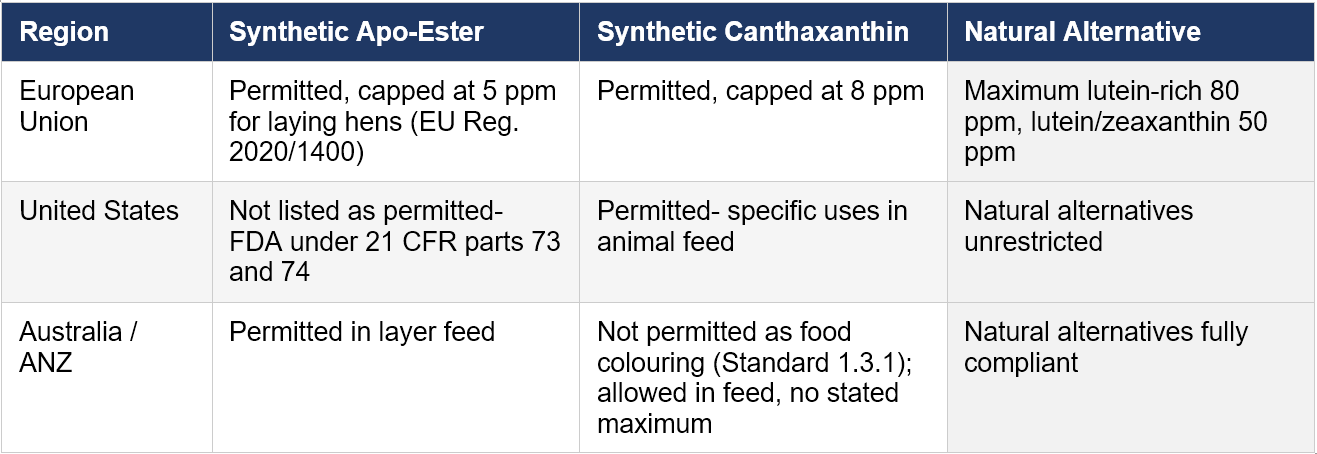
In the EU, Commission Implementing Regulation 2020/1400 set the maximum inclusion rate for apo-ester at 5 mg/kg complete feed for laying hens following a re-evaluation by EFSA. The authority could not rule out inhalation risk for workers, and simultaneous use in drinking water was prohibited to prevent cumulative xanthophyll limits being exceeded. These constraints reflect the scrutiny synthetic molecules now attract routinely, not exceptionally.
In ANZ, synthetic canthaxanthin sits in an awkward position: excluded as a food colouring but not subject to a stated maximum when used in layer feed. That gap will not stay open indefinitely. Switching to Xarocol, the paprika-based natural red pigment, removes the exposure entirely.
4. Performance: The Trial Data
The historical objection to natural yellow pigments was straightforward. Traditional marigold-derived lutein and zeaxanthin required roughly three times the inclusion rate of apo-ester to achieve the same yolk colour score, because intestinal absorption is lower. The economics did not stack up.
EW Nutrition’s proprietary production process changes that. By improving carotenoid bioavailability at the manufacturing stage, Colortek Yellow reduces the dose ratio to 1.25 to 1 against apo-ester. Two independent trials confirm the result holds in commercial conditions.
IRTA trial, Spain (288 Hy-Line Brown layers, 39 weeks)
Seven weeks of xanthophyll depletion followed by four weeks of treatment. Three yolk colour fan targets tested (YCF 10, 11, 12). Colortek Yellow tested at 1.25x the apo-ester dose. Statistical significance at P<0.05.
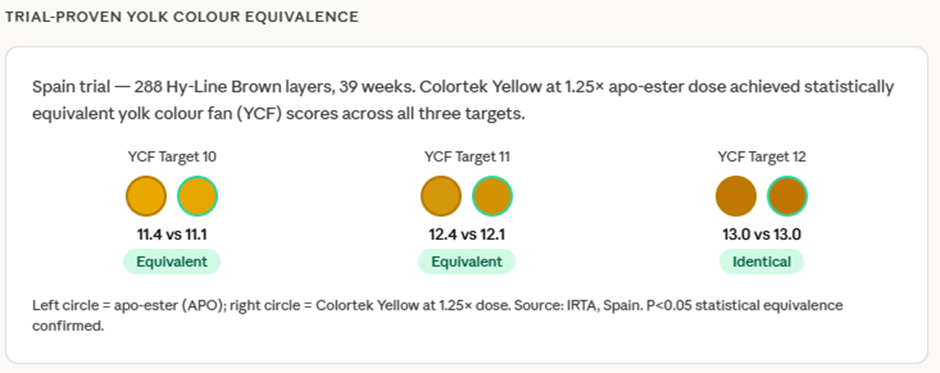

At 1.25x the apo-ester dose, Colortek Yellow matched apo-ester across all three targets. The trial also found that standard apo-ester dosing recommendations were overestimated, producing scores roughly one point above target. Producers may already be using more synthetic pigment than they need.
Field validation, Spain (57,000 hens)
Under commercial conditions at scale, Colortek Yellow at a 1.25:1 ratio produced equivalent yolk colour scores to apo-ester (12.5 versus 12.7). The laboratory result holds in the field.
5. Stability
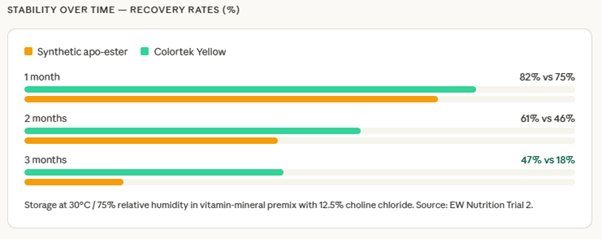
Lower stability in premix storage has been a legitimate concern with natural pigments. EW Nutrition addresses this through an accelerated saponification process that produces a low-moisture, high-xanthophyll product. The difference at extended storage is substantial.
Storage conditions: vitamin-mineral premix containing 12.5% choline chloride, closed bags, 30 degrees C, 75% relative humidity.

After three months, apo-ester retains 18% of active ingredient. Colortek Yellow retains 47%. For a premix manufacturer or feed mill running standard storage cycles, this is not a marginal difference. It means less product degradation between manufacture and use, more consistent on-farm results, and a lower effective cost per unit of pigmentation delivered.
6. Antioxidant Protection
Synthetic apo-ester is a synthetic colourant, only. Marigold-derived lutein and zeaxanthin colourants are also antioxidants, and that matters in the yolk because egg lipids oxidise readily, particularly during processing and extended retail.
Lutein and zeaxanthin also deposit in human tissue via consumption of enriched eggs, where their role in reducing cataract risk and age-related macular degeneration is documented (Landrum and Bone, 2001; Wang et al., 2016). This is the basis for functional egg positioning in premium markets, particularly in countries where antioxidant-enriched eggs are established retail categories.
7. Colortek Yellow: Product Specifics
Colortek Yellow is a 10% concentrated marigold extract produced at EW Nutrition’s FAMI-QS certified facility in Spain. Key characteristics:
- Carotenoid source: Tagetes erecta (marigold) flower extract, lutein and zeaxanthin
- Concentration: 10% active carotenoids
- Dose ratio: 1.25:1 against synthetic apo-ester, confirmed in multiple independent trials
- Stability: higher 3-month recovery than apo-ester under accelerated storage conditions
- Physical form: free-flowing powder, homogeneous mixing in feed
- Certification: FAMI-QS, EU manufactured, strict control of undesirable substances
- Red pigment complement: Xarocol, paprika-based, natural alternative to synthetic canthaxanthin
- Australian distribution: Premium Agriproducts
8. Summary
Synthetic apo-ester is under regulatory pressure in every major market and faces outright prohibition in others. The performance gap that previously justified its use has closed. Colortek Yellow delivers equivalent yolk colour at 1.25 times the dose, better stability at three months, and antioxidant protection that synthetic pigments cannot match.
For Australian producers, the benefits from use of natural pigments are supported by the current regulatory positions held on synthetic canthaxanthin and by the export opportunity in Asian markets where deep, consistent yolk colour from natural sources commands a premium. The Egg Farmers of Australia’s own guidance points to carotenoid source selection and hen health management as the foundations of a reliable pigmentation program. Colortek Yellow and Xarocol are built on exactly those foundations.
References
- EU Commission Implementing Regulation 2020/1400, 5 October 2020.
- Hashimoto, M. (2026). Egg yolk pigmentation: what drives colour and why it matters. National Poultry Newspaper, Vol 9 No. 3, March 2026.
- Grashorn, M. (2008). Eiqualitat. In Legehuhnzucht und Eiererzeugung, Landbauforschung special issue 322.
- Grashorn, M. (2016). Feed additives for influencing chicken meat and egg yolk color. In Handbook on Natural Pigments in Food and Beverages. Woodhead Publishing.
- Landrum, J.T. and Bone, R.A. (2001). Lutein, zeaxanthin, and the macular pigment. Archives of Biochemistry and Biophysics 385(1):28-40.
- Wang, W. et al. (2016). Antioxidant supplementation increases retinal responses in dogs. J. Nutr. Sci. 5 e18.
- EW Nutrition internal trial data, IRTA Spain (288 layers) and commercial field trial (57,000 hens).







 Brasil
 Colombia (ES)
 México (ES)
 United States
 Belgium (EN)
 Croatia (EN)
 Deutschland
 España
 France
 Great Britain
 Italia
 Nederland (EN)
 Österreich (DE)
 Polska
 Россия
 Schweiz (DE)
 Türkiye
 Україна (RU)
 عربى
عربى South Africa (EN)
 Morocco
 Nigeria
 Uganda
 Kenya
Kenya Tanzania
 Australia
 中国大陆
中国大陆 India (EN)
 日本
日本 Malaysia (EN)
 Philippines (EN)
 ไทย (EN)
 Việt Nam (EN)
