Feed Quality · Pelleting and Moisture Management

Keep the moisture you have already paid for

Surf·Ace is a surfactant-based liquid premix that mitigates moisture losses through conditioning and pelleting, improving pelleting efficiency and pellet quality while reducing energy use.

Species

All species

Application

Feed mill, pelleting line

Active principle

Propionic acid and salt, glyceryl polyethylene glycol ricinoleate (PEGR)

Feed Quality

Yield, pellet quality and energy are one problem

Every point of moisture lost between the mixer and the cooler is product weight the mill has paid for and cannot sell. It is also disrupting the balance of the diet the nutritionist meticulously formulated. The loss is not only commercial. The same water that leaves through the die and the cooler is the water that would have made conditioning effective, and its absence is paid for a second time in pellet durability and in throughput. Surf·Ace is the intervention at the conditioner.

Water added at the conditioner does not distribute itself. Applied to a mash without a surfactant it sits where it lands, wets the surface of the particle rather than penetrating it, and leaves again through the die and the cooler. The mill meets the consequences in three separate places and usually treats them as three separate problems: shrinkage, poor pellet durability, and energy consumption per ton. They are one problem.

*All products, services, and recommendations are country-dependent and may differ based on local compliance.

Feed Quality

How the surfactant works

0

Surfactant action.

Surf·Ace is a surfactant that lowers the surface tension of added water so it wets and penetrates the mash more completely, improving moisture distribution in the conditioner and reducing moisture loss through the die and cooler.

0

More conditioning from the same steam.

Water that has penetrated the particle emulsifies better with the oil thanks to Surf·Ace, thus improving starch gelatinization, which is what conditioning is for. The same steam input does more work and friction through the die is reduced, leading to higher throughput with lower energy.

0

Preservative base.

The formulation is built on propionic acid and ammonium propionate, so moisture retained through the process does not translate into mold risk in storage.

0

Process economics.

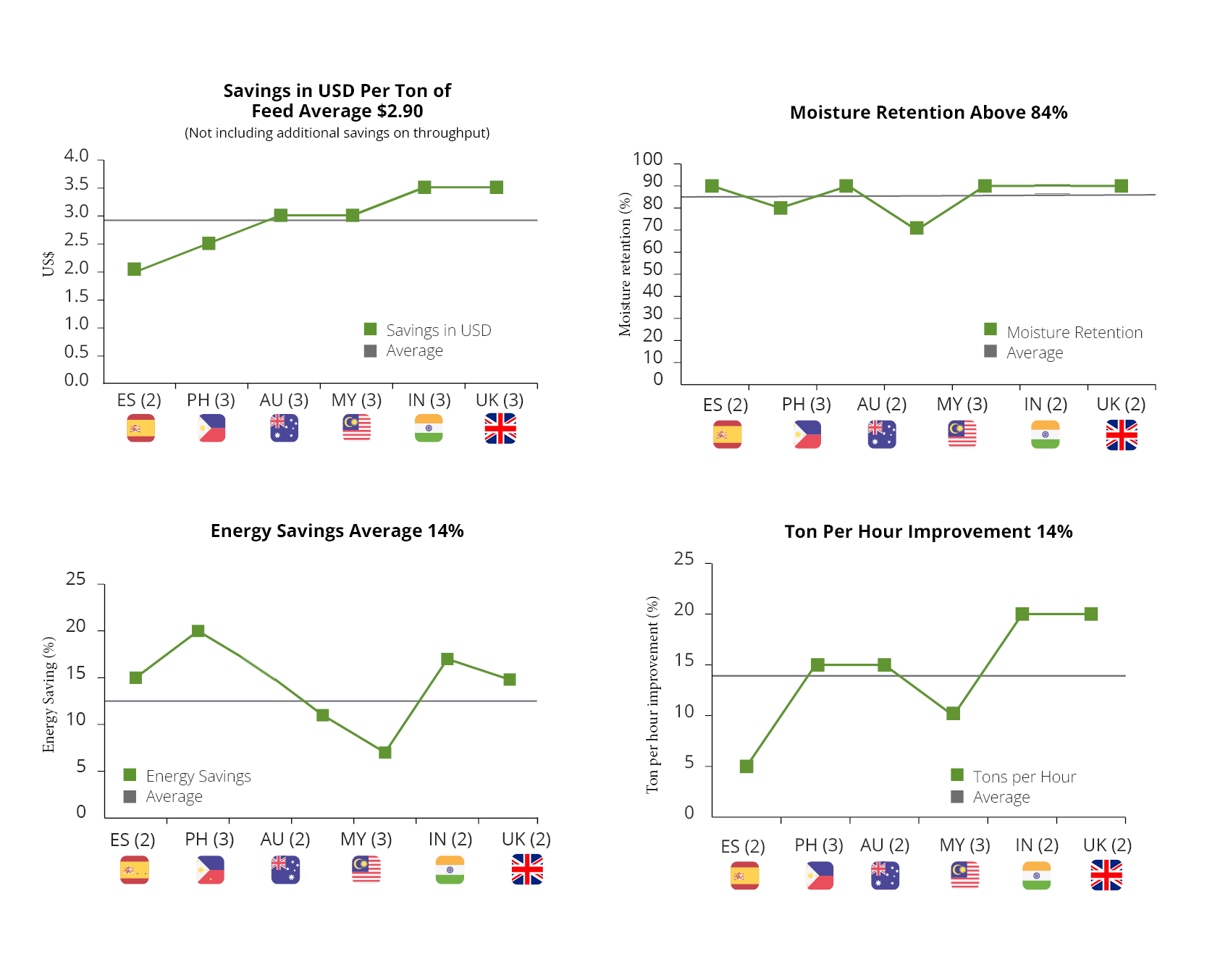
Where moisture is retained and starch gelatinization is improved, mills typically see gains in throughput, pellet durability and energy consumption. The size of the effect is mill- and feed recipe-specific and is established by trial on the line.

Feed Quality

Products in the range

Moisture management for higher quality pellets

A liquid surfactant premix that mitigates moisture losses during feed production, improving pelleting efficiency and pellet quality while reducing energy use. Applied as part of a tailored program built around each mill’s process conditions.

Form

Clear brown liquid

Target species

All species

Active principle

Propionic acid, ammonium propionate, glyceryl polyethylene glycol ricinoleate (PEGR)

Application

Feed mill, pelleting line

Packaging

200 kg drum, 1000 kg IBC

Shelf life

24 months

Availability

Varies (check with your local representative)

Feed Quality

Technical notes

Process integration.

Surf·Ace results depend on conditioning temperature, retention time, die specification and formula. Application is set up per mill rather than at a standard rate.

Retention, not addition.

The product is positioned and dosed to hold moisture that is already being added, not to raise the declared moisture content of the feed. Confirm the wording against national feed labelling rules.[

Measurement.

Because the effect is a difference measured across the line, a trial needs baseline figures before the product is introduced: moisture at the mixer and after the cooler, pellet durability index, and kWh per ton.

Feed Quality

What the trials show

Feed Quality

Where it fits

Surf·Ace acts at the conditioner, which makes it a mill decision rather than a formulation decision. It is set up per line, against that line’s conditioner temperature, retention time, die specification and formula. Mills running high-fat or high-fiber formulas, and mills pushing throughput against a durability specification, have the most to gain. The program is built from baseline measurements on the line, not from a standard inclusion rate.

Get in touch

Measure the line before you change it

Our specialists set up a trial on your line, with baseline moisture, durability and energy figures to measure against.