Secondary Plant Compounds (SPC’s) to reduce the use of antibiotics?

Initial in vitro trials give reason for hope
Antibiotic Resistance
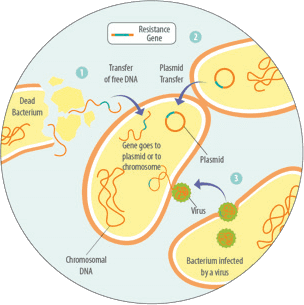
Some bacteria, due to mutations, are less sensitive to certain antibiotics than others. This means that if certain antibiotics are used, the insensitive ones survive. Because their competitors have been eliminated, they are able to reproduce better. This resistance can be transferred to daughter cells by means of „resistance genes“. Other possibilities are the intake of free DNA and therefore these resistance genes from dead bacteria 1, through a transfer of these resistance genes by viruses 2 or from other bacteria by means of horizontal gene transfer 3 (see figure 1). Every application of antibiotics causes a selection of resistant bacteria. A short-term use or an application at a low dosage will give the bacteria a better chance to adapt, promoting the generation of resistance (Levy, 1998).
Antibiotics are promoting the development of resistance:
- Pathogenic bacteria possessing resistance genes are conserved and competitors that do not possess these genes are killed
- Useful bacteria possessing the resistance genes are conserved and serve as a gene pool of antibiotic resistance for others
- Useful bacteria without resistance, which probably could keep the pathogens under control, are killed
Reducing the use of antibiotics
Ingredients from herbs and spices have been used for centuries in human medicine and are now also used in modern animal husbandry. Many SPC’s have antimicrobial characteristics, e.g. Carvacrol and Cinnamon aldehyde. They effectively act against Salmonella, E. coli, Pseudomonas aeruginosa, Klebsiella pneumoniae, Entero– and Staphylococcus, and Candida albicans. Some compounds influence digestion, others act as antioxidants. Comprehensive knowledge about the single ingredients, their possible negative but also positive interaction (synergies) is essential for developing solutions. Granulated or microencapsulated products are suitable for addition to feed, liquid products would be more appropriate for an immediate application in the waterline in acute situations.
SPC’s (Activo Liquid) against livestock pathogens in vitro
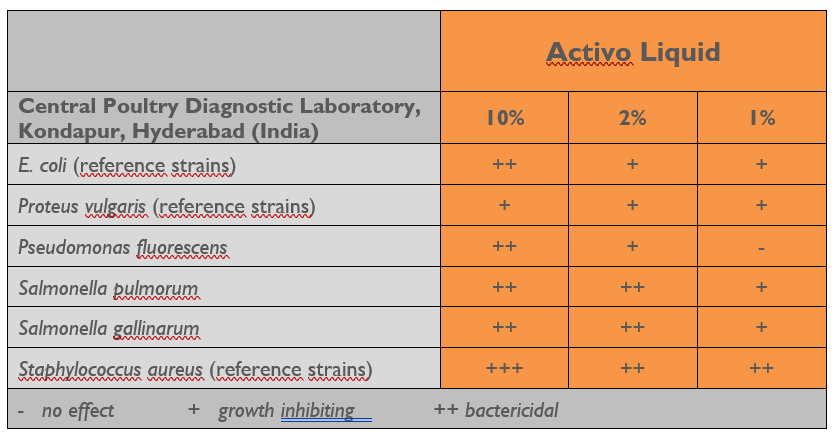
In “agar diffusion tests”, the sensitivity of different strains of farm-specific pathogens was evaluated with different concentrations of Activo Liquid. The effectiveness was determined by the extent to which they prevented the development of bacterial overgrowth. The larger the bacteria-free zone, the higher the antimicrobial effect.
In this trial, Activo Liquid showed an antimicrobial effect on all bacteria tested. The degree of growth inhibition positively correlated with its concentration.
Table 1: Inhibition of field isolated standard pathogens by different concentrations of Activo Liquid
Activo Liquid against antibiotic resistant field pathogens in vitro
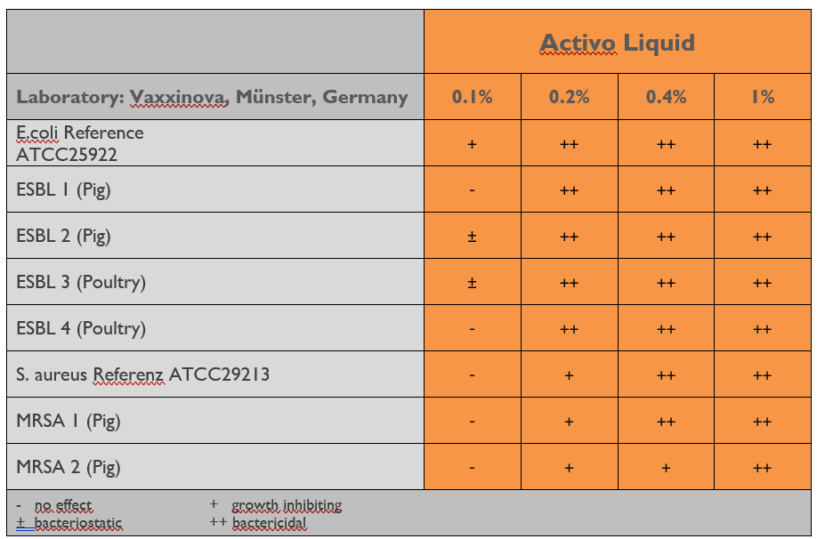
It cannot be excluded that resistant pathogens not only acquired effective weapons to render antibiotics harmless to them but also developed general mechanisms to rid themselves of otherwise harmful substances. In a follow-up laboratory trial, we evaluated whether the Activo Liquid composition is as effective against ESBL producing E. coli and Methicillin resistant S. aureus (MRSA) as to non-resistant members of the same species.
Trial Design: Farm isolates of four ESBL producing E. coli and two MRSA strains were compared to nonresistant reference strains of the same species with respect to their sensitivity against Activo Liquid. In a Minimal Inhibitory Concentration Assay (MIC) under approved experimental conditions (Vaxxinova Diagnostic, Muenster, Germany) the antimicrobial efficacy of Activo Liquid in different concentrations was evaluated.
The efficacy of SPC’s (Activo Liquid) against the tested strains could be demonstrated in a concentration-dependent manner with antimicrobial impact at higher concentrations and bacteriostatic efficacy in dilutions up to 0,1% (ESBL) and 0,2% (MRSA)(table 2).
Conclusion:
To contain the emergence and spread of newly formed resistance mechanisms it is of vital importance to reduce the use of antibiotics. SPC’s are a possibility to decrease antibiotic use especially in pro- and metaphylaxis, as they show good efficacy against the common pathogens found in poultry, even against resistant ones.
I. Heinzl